Give or treat yourself to a subscription to Boats in Motion print + digital and for only 39 euros a year you get the magazine at home plus read it on your PC, smartphone and tablet. With a sea of advantages.
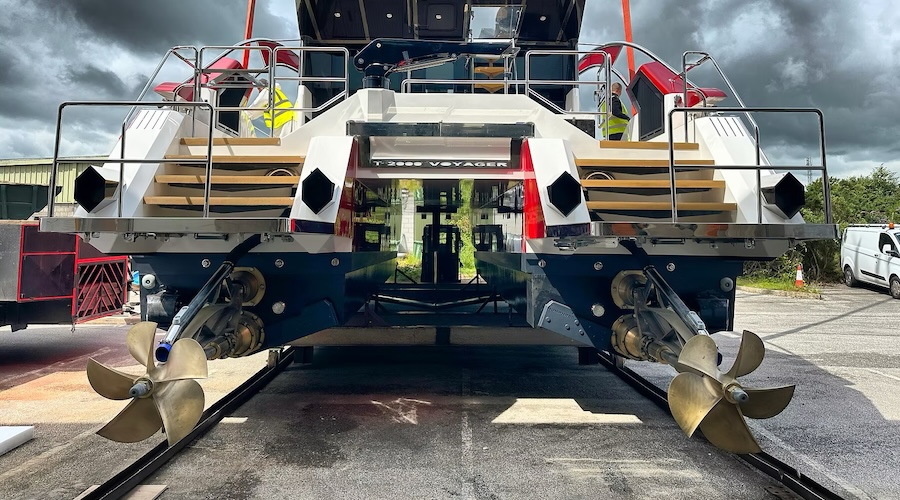
The T-2000 Voyager , “extreme” multihull with surface propellers
Surface propellers are an established reality and one of the most significant developments in marine propulsion in recent decades. The basic concept is simple: reduce drag to increase speed.surface propellers catamarans
A boat’s drag is generated mainly by wave resistance and friction resistance. Surface propellers are specifically designed to operate partially submerged (about half the diameter) and, working under these unique conditions, achieve a double advantage: the reduction of friction when the blade leaves the water, because the hydrodynamic resistance is drastically reduced compared to a totally submerged propeller, and the exploitation of controlled cavitation, which, unlike conventional propellers, is necessary in this system.
he profile of the blades, in fact, is designed to trap air during emergence, creating a “supercavitation” phenomenon that generates greater thrust and faster propeller rotation.
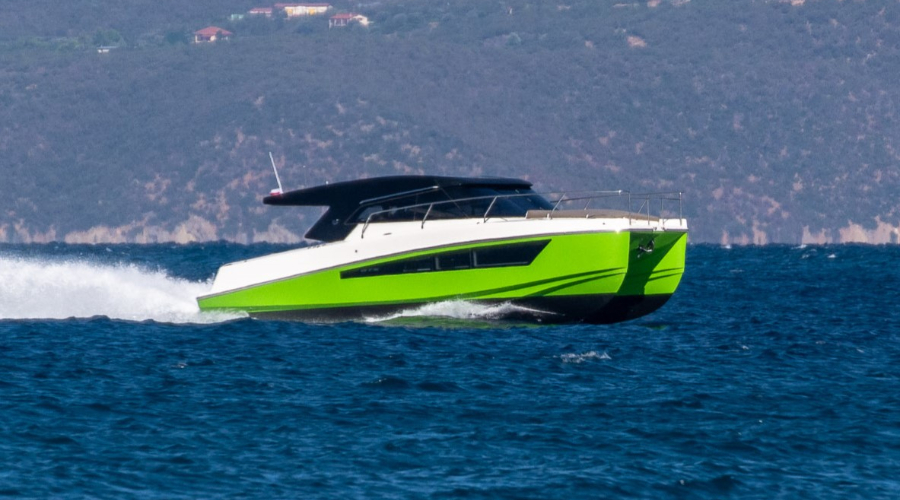
Makai 37 GTS with surface propellers
Having made the necessary technical premise, it is understandable why usually this type of transmission is found on powerful, high-performance boats. In recent times, however, we are seeing the depopulation of multihulls, so why not equip them with surface propellers?
It was at the Croatian Makai shipyard that we asked what led them to choose surface propellers and the advantages of them.
“Surface propulsion ,” Emanuele Rossi, of Eryd Studio, which designed the Makai 37 GTS, tells us. – has always been synonymous with extreme performance and speed. However, our choice of the Q-SPD surface drive system goes beyond mere performance gain. Our main goal was to offer boaters, who keep their boats on the water, a solution that would provide a dramatic reduction in cost and maintenance time compared to traditional Z-drives (inboard or stern-drive ed.), without any compromise on efficiency and performance.” The Q-SPD transmission
Q-SPD transmissions, a system that takes an unconventional approach to the world of surface propulsion, were used on the Croatian catamaran. Unlike many competitors who use articulated transmissions (which often do not guarantee longevity and ease of maintenance), Q-SPDs are distinguished by a superior engineering design. In fact, they have a fixed shaft with composite housing, which includes the double rudder blades, exhaust, shaft, and propeller. The result is a system that offers the simplicity and reliability of a typical shaft drive, but with all the efficiency advantages of a surface drive.
The advantages of surface propellers on a catamaran
What are the real advantages of this type of surface propeller for a yachtsman?
“First of all,” Emanuele tells us, “the modifications required to switch from a Z-drive transmission to the Q-SPD system are minimal. Any vessel originally equipped with a Z-drive transmission can be easily reconfigured with a surface drive. The only requirement is the availability of space in the engine room, as the engines will have to be repositioned slightly further forward.”
Did the Q-SPDs affect the initial design of the catamaran, equipped with foils?
“On the Makai 37 GTS, these propellers were mounted in conjunction with a hydrofoil system, which matches exceptionally well, going on to optimize performance, produce increased speed and generate a dynamic stern lift. Under maximum speed conditions, this system allows the boat’s draft to be reduced to just 45 centimeters, providing greater peace of mind and access to shallow water.”
One of the flaws of surface propellers is maneuverability, a critical point even of multihulls in confined waters. Together are they not an “explosive” mix?
“With twin-engine catamarans having a large separation between transmissions, the maneuverability is fantastic. The boat can be effortlessly handled simply by using the throttles (forward and reverse), just as would be done with any catamaran with a shaft or sail drive. By adding a bow thruster (bow thruster) and an integrated joystick, control in port becomes totally intuitive.”
Q-SPDs were also fitted on the Makai 37 GTS in an effort to keep fuel consumption down, and, in fact, the data speak for themselves: above 25 knots, there are real savings of about 10 percent compared to counter-rotating Z transmissions, and the advantage rises to about 15 percent over typical shaft drives.
Powerboats, its stories, from small open to motoryachts. Sign up now for our free newsletter and receive the best news selected by the editorial staff each week. Enter your email below, agree to the Privacy Policy and click the “sign me up” button.
Welcome to the special section “BAM 35 Years.” We are presenting “cult” articles from the Motor Boats archive, starting in 1990. A journey through time among stories unobtainable today, even in the great sea of the internet! A dive into
Welcome to the special section “BAM 35 Years.” We are presenting “cult” articles from the Motor Boats archive, starting in 1990. A journey through time among stories unobtainable today, even in the great sea of the internet! A dive into
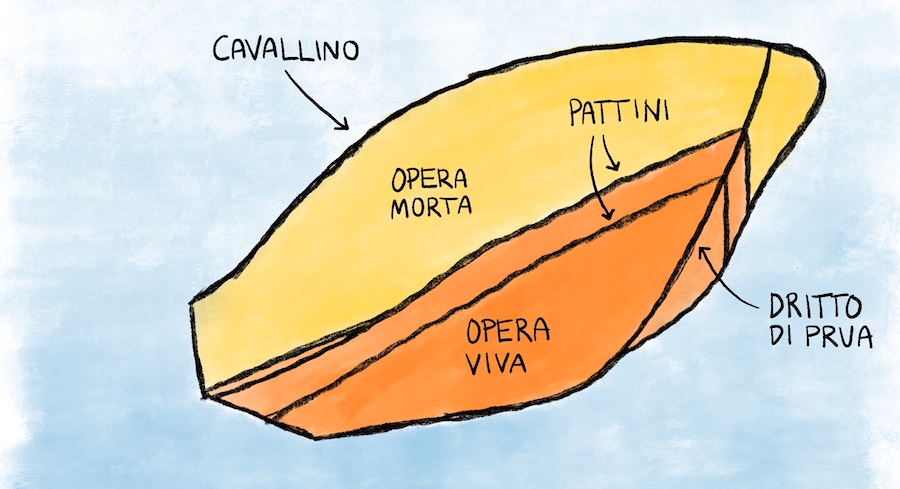
When we write our tests, we talk about live opera, dead opera, skids and deadrise. All these names, to the most experienced are clear, but not everyone is familiar with the technical jargon. Yet these terms are fundamental to understanding
Welcome to the special section “BAM 35 Years.” We are presenting “cult” articles from the Motor Boats archive, starting in 1990. A journey through time among stories unobtainable today, even in the great sea of the internet! A dive into
Gestisci Consenso Cookie
Per fornire le migliori esperienze, utilizziamo tecnologie come i cookie per memorizzare e/o accedere alle informazioni del dispositivo. Il consenso a queste tecnologie ci permetterà di elaborare dati come il comportamento di navigazione o ID unici su questo sito. Non acconsentire o ritirare il consenso può influire negativamente su alcune caratteristiche e funzioni.
Funzionale
Always active
L'archiviazione tecnica o l'accesso sono strettamente necessari al fine legittimo di consentire l'uso di un servizio specifico esplicitamente richiesto dall'abbonato o dall'utente, o al solo scopo di effettuare la trasmissione di una comunicazione su una rete di comunicazione elettronica.
Preferenze
L'archiviazione tecnica o l'accesso sono necessari per lo scopo legittimo di memorizzare le preferenze che non sono richieste dall'abbonato o dall'utente.
Statistiche
L'archiviazione tecnica o l'accesso che viene utilizzato esclusivamente per scopi statistici.L'archiviazione tecnica o l'accesso che viene utilizzato esclusivamente per scopi statistici anonimi. Senza un mandato di comparizione, una conformità volontaria da parte del vostro Fornitore di Servizi Internet, o ulteriori registrazioni da parte di terzi, le informazioni memorizzate o recuperate per questo scopo da sole non possono di solito essere utilizzate per l'identificazione.
Marketing
L'archiviazione tecnica o l'accesso sono necessari per creare profili di utenti per inviare pubblicità, o per tracciare l'utente su un sito web o su diversi siti web per scopi di marketing simili.