Give or treat yourself to a subscription to Boats in Motion print + digital and for only 39 euros a year you get the magazine at home plus read it on your PC, smartphone and tablet. With a sea of advantages.
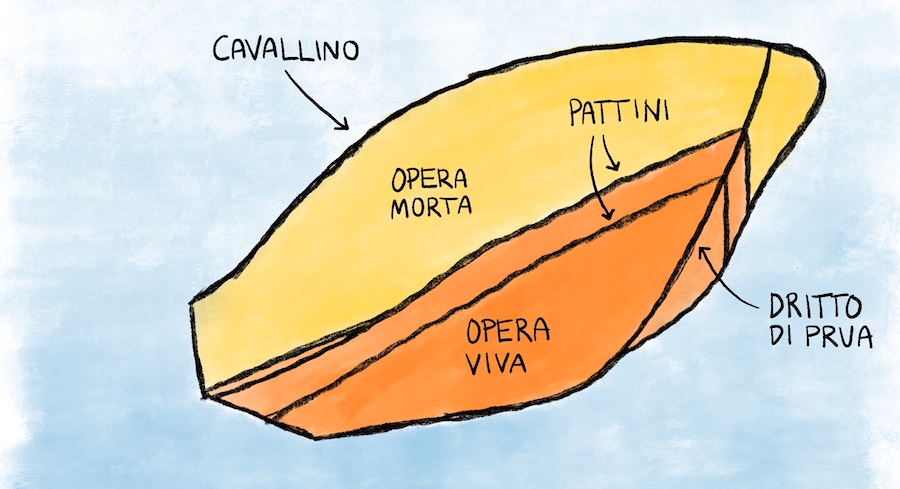
Identikit of a boat: the hull | Illustrations by Erika Baffìco – Fulcro Design
When we write our tests, we talk about live opera, dead opera, skids and deadrise. All these names, to the most experienced are clear, but not everyone is familiar with the technical jargon. Yet these terms are fundamental to understanding a hull and its characteristics. Therefore, we decided to sketch a boat’s hull and its parts.
We also decided to illustrate it so that it is easier for everyone to understand what we are talking about.
The first element that describes a hull is its dihedral, in English deadrise, which is the slope of the bottom of the hull, measured from the keel toward the sides, on a cross section of the boat.
Basically, the angle formed by the hull of a boat relative to the horizontal water line.
The higher this number, the “sharper” the hull. Beware, however, that all pleasure boats have what is known as a variable V, deeper at the bow (first of all to allow for better crossing of water and waves) and more open at the stern (mainly to make it easier to enter the plane and to give more stability when the boat is stationary). This means that when we talk about hull angle, it is always necessary to specify whether it refers to the stern sections (the most significant, at least on normal cruising boats) or the bow sections.
Illustrations by Erika Baffìco – Fulcro Design
The perfect stern angles
It is of course impossible to say; it depends on the speed and use of the boat. Having to give reference numbers, it can be said that standing on 22°/24° the boat will have good passage over the wave, especially at high speeds, but it will also have less stability in the roadstead and more consumption at the same speed. On the opposite, with a hull with a stern angle of about 18°/20° (most of those on the market) you will have a more “all round” behavior, not focused on extreme performance but on comfort.
Powerboats, its stories, from small open to motoryachts. Sign up now for our free newsletter and receive the best news selected by the editorial staff each week. Enter your email below, agree to the Privacy Policy and click the “sign me up” button.
Welcome to the special section “BAM 35 Years.” We are presenting “cult” articles from the Motor Boats archive, starting in 1990. A journey through time among stories unobtainable today, even in the great sea of the internet! A dive into
Welcome to the special section “BAM 35 Years.” We are presenting “cult” articles from the Motor Boats archive, starting in 1990. A journey through time among stories unobtainable today, even in the great sea of the internet! A dive into
Welcome to the special section “BAM 35 Years.” We are presenting “cult” articles from the Motor Boats archive, starting in 1990. A journey through time among stories unobtainable today, even in the great sea of the internet! A dive into
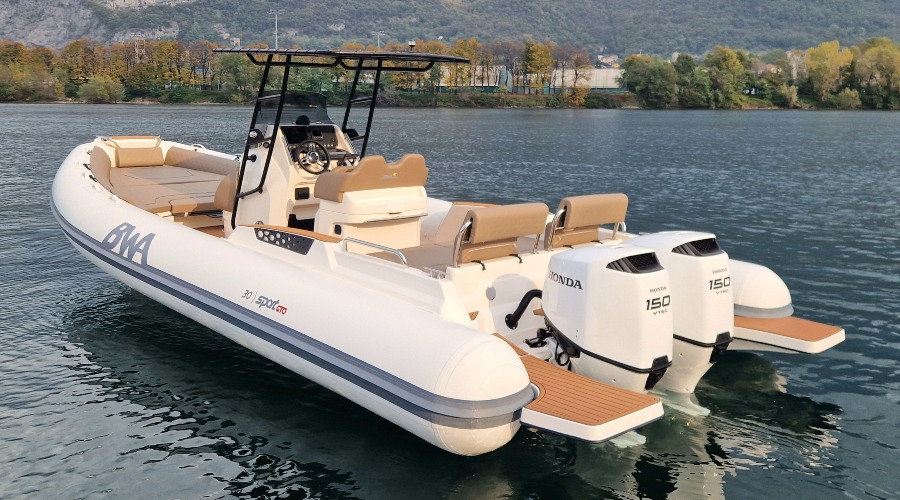
BWA Sport 30 GTO is an inflatable boat designed to provide a comfortable and versatile boating experience, without ever sacrificing the typical style of the Lombard shipyard. What it’s like on board The interior design is conceived to allow comfortable
Gestisci Consenso Cookie
Per fornire le migliori esperienze, utilizziamo tecnologie come i cookie per memorizzare e/o accedere alle informazioni del dispositivo. Il consenso a queste tecnologie ci permetterà di elaborare dati come il comportamento di navigazione o ID unici su questo sito. Non acconsentire o ritirare il consenso può influire negativamente su alcune caratteristiche e funzioni.
Funzionale
Always active
L'archiviazione tecnica o l'accesso sono strettamente necessari al fine legittimo di consentire l'uso di un servizio specifico esplicitamente richiesto dall'abbonato o dall'utente, o al solo scopo di effettuare la trasmissione di una comunicazione su una rete di comunicazione elettronica.
Preferenze
L'archiviazione tecnica o l'accesso sono necessari per lo scopo legittimo di memorizzare le preferenze che non sono richieste dall'abbonato o dall'utente.
Statistiche
L'archiviazione tecnica o l'accesso che viene utilizzato esclusivamente per scopi statistici.L'archiviazione tecnica o l'accesso che viene utilizzato esclusivamente per scopi statistici anonimi. Senza un mandato di comparizione, una conformità volontaria da parte del vostro Fornitore di Servizi Internet, o ulteriori registrazioni da parte di terzi, le informazioni memorizzate o recuperate per questo scopo da sole non possono di solito essere utilizzate per l'identificazione.
Marketing
L'archiviazione tecnica o l'accesso sono necessari per creare profili di utenti per inviare pubblicità, o per tracciare l'utente su un sito web o su diversi siti web per scopi di marketing simili.