Give or treat yourself to a subscription to Boats in Motion print + digital and for only 39 euros a year you get the magazine at home plus read it on your PC, smartphone and tablet. With a sea of advantages.
Welcome to the special section “BAM 35 Years.” We are presenting “cult” articles from the Motor Boats archive, starting in 1990. A journey through time among stories unobtainable today, even in the great sea of the internet! A dive into the world of epic moments in motor boating. We begin with one of the stories we were most passionate about.
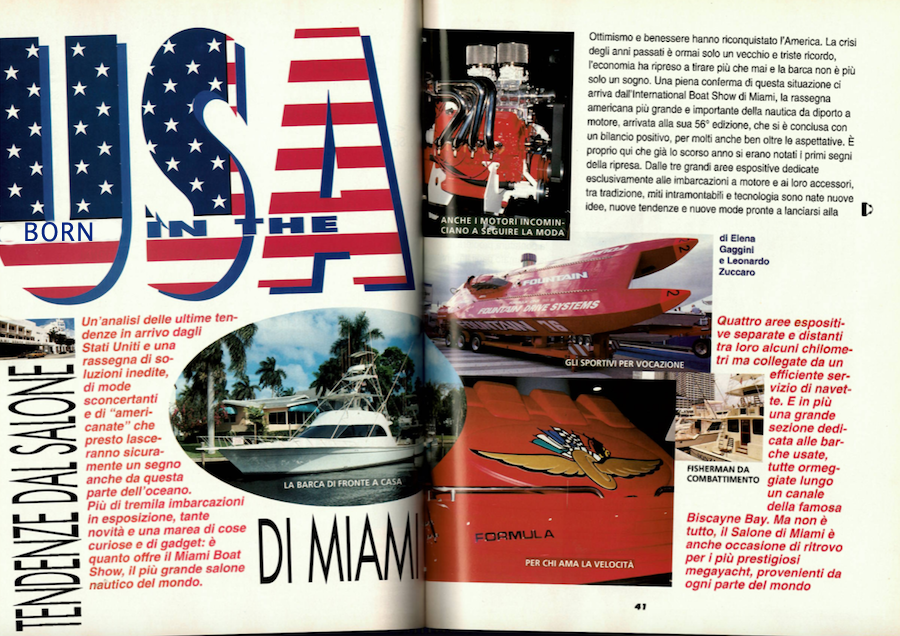
Trends from the Miami show
From Boats to Motor 1997, no. 3, April, pp. 40-49.
An analysis of the latest trends coming out of the United States and a review of novel solutions, bewildering fashions and “Americana” that are sure to leave a mark soon on this side of the ocean as well. More than three thousand boats on display, lots of novelties and a flood of curious things and gadgets: this is what the Miami Boat Show, the world’s largest boat show, has to offer. Four separate exhibition areas several miles apart but connected by a efficient shuttle service. Plus a large section dedicated to used boats, all moored along a canal in the famous Biscayne Bay. But that’s not all, the Miami Boat Show is also a gathering occasion for the most prestigious megayachts, from all over the world.
Optimism and prosperity have won America back. The crisis of years past is now just an old and sad memory, the economy has picked up more than ever, and boating is no longer just a dream. Full confirmation of this comes to us from the International Boat Show in Miami, the largest and most important American motor boating show, now in its 56th year, which ended on a positive note, for many even well beyond expectations. It was here that the first signs of recovery were already noticed last year. From the three large exhibition areas dedicated exclusively to motor boats and their accessories, between tradition, timeless myths and technology, new ideas, new trends and new fashions were born, ready to launch themselves to the conquest of foreign markets. The return to the desire to spend on the part of the “medium class,” the one that really makes up the numbers and reflects and determines the real health of a country’s economy, explains the high concentration of new models precisely in the medium-small boat segment, up to 12 meters. To the younger and more sporty user, the one who made the jet ski fashion his own, the shipyards now offer a wide and very colorful range of small hulls with jet engines, much more comfortable than motorcycles but no less fun. The traditional speedboat, the one with the bow pontoon and so beloved by Italians, overseas can now be considered to be dying out, in its place the more habitable bow riders, which have already been on the American market for some 20 years, but are constantly evolving. Now the bow area is being exploited more and more and better, so much so that the very latest trends have almost entirely transformed it. Indeed, stern and bow have become virtually the same, the same width and both equipped with a swim platform and ladder.
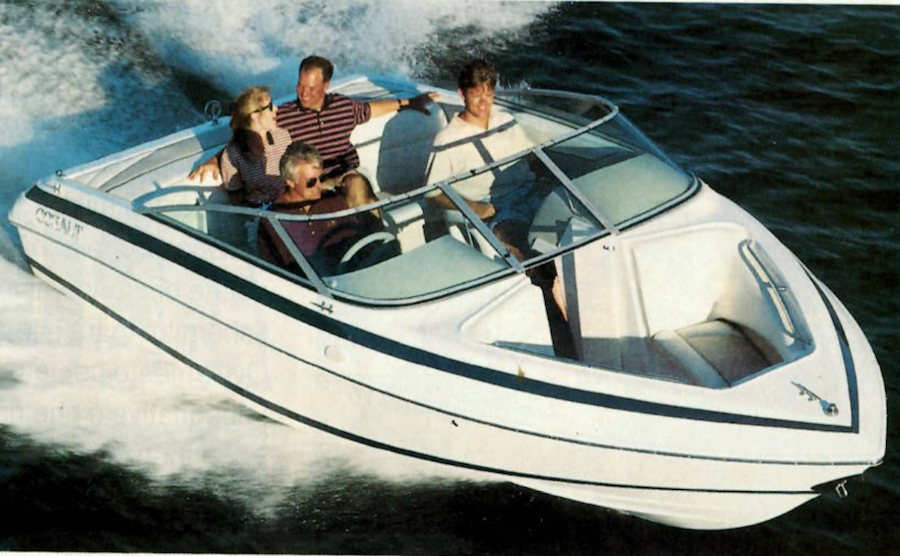
The bow rider version of the speedboat is always a favorite among Americans. It offers little storage volume but, on the other hand, allows more people to be comfortably accommodated. Pictured is the Cobalt 200.
But the real star of this show is, as always after all, the fisherman. In America, in fact, deep-sea fishing is a real mass phenomenon. To reach the most fishy waters, such as those in Florida, that is, those where the Gulf Stream transits, true enthusiasts travel hundreds and hundreds of miles. It is therefore necessary to have fast, safe boats with great autonomy: basically the fisherman in all its types. Obviously, for the most demanding fishing trips that require long stays at sea, the ideal boat is the classic convertible over 10 meters with a high, flared bow, to cope with even the most inaccessible sea conditions with extreme safety, and a stern with a very low freeboard, to facilitate the boarding of prey. Also of this size, the fashion for “open fisherman” is definitely gaining popularity, launched in recent years by the best-known shipyards in the industry and already very popular in the Mediterranean as well. These are hulls that, while reproducing the same lines as convertibles, are without the superstructure that houses the flying bridge, and have the wheelhouse in the cockpit. The latter generally has two levels, a lower, uncluttered aft level, where the fighting chair and live and catch tanks are located; the other, slightly higher level, houses the pilot seat and seats for the co-pilot and other guests. This area also is often overlooked and protected by a tuna tower for spotting prey, the main accessory that avid fishermen simply cannot do without.
Voyager Marine’s Scratch. 4.42 meters long.
Dedicated to fishing and very successful are also the smaller walk-around cabin cruisers, which are increasingly rich in equipment stowage volumes. The cabin is comfortable enough to allow one to spend, obviously without too much pretension, even a few nights on board. For shorter fishing trips, moreover, open hulls such as center consoles are very popular, and they have begun to gather a lot of support from the Italian market as well. Typically American, on the other hand, are those boats with flat hulls and large outboard motors, ideal for moving in the shallow waters of the fishy lagoon areas. Turning to the classic cruising sector, of note are the great advances achieved by day and express cruiser manufacturers in the exploitation of interior volumes. Spaces are now spacious and bright, and the trend of a few years ago of manufacturers competing to fit more berths on boats of equal size has finally disappeared. The same considerations can be echoed with regard to flying bridges, which, however, often find themselves in competition with convertibles, which are now able to offer maximum comfort even to those who really don’t want to know about fishing. For quiet, unhurried sailing, trawlers are regaining ground; in the wake of the now legendary Grand Banks other yards are producing good boats. Even pilothouses, a middle ground between the trawler and the traditional motoryacht, which have not yet managed to conquer our seas, are appreciated by several American boaters.
Building on the success of jet boats, Bombardier Group’s See Doo offers the Explorer. This is a hard-hulled inflatable boat that rides like a jet ski but where you are definitely more comfortable and dry.
So much so that there is a growing fashion for what can be called “houseboats'”, aesthetically not beautiful but exceptionally comfortable and practical, despite their small size, for prolonged stays on board, with nothing to envy the comfort of home. But even Americans who love pure speed have nothing to complain about: in fact, there are numerous shipyards that devote at least part of their production to building superfast hulls, monohulls or catamarans. Very narrow, with completely flat decks, wrap-around seats, the ever-present aft sundeck cushion, cozy but stripped-down cabins, and roaring engines, these boats are becoming increasingly colorful and flashy, with dashboards and engines strictly matching.
A Mares cruising catamaran.
Powerboats, its stories, from small open to motoryachts. Sign up now for our free newsletter and receive the best news selected by the editorial staff each week. Enter your email below, agree to the Privacy Policy and click the “sign me up” button.
Welcome to the special section “BAM 35 Years.” We are presenting “cult” articles from the Motor Boats archive, starting in 1990. A journey through time among stories unobtainable today, even in the great sea of the internet! A dive into
Welcome to the special section “BAM 35 Years.” We are presenting “cult” articles from the Motor Boats archive, starting in 1990. A journey through time among stories unobtainable today, even in the great sea of the internet! A dive into
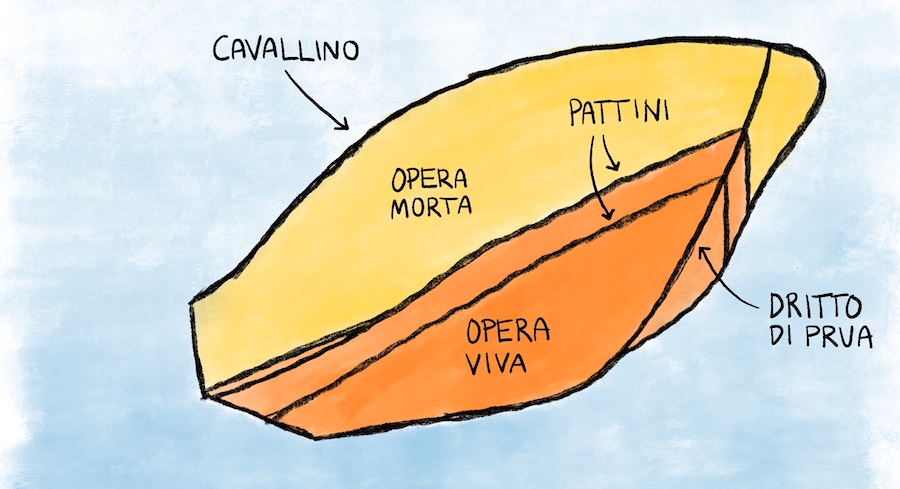
When we write our tests, we talk about live opera, dead opera, skids and deadrise. All these names, to the most experienced are clear, but not everyone is familiar with the technical jargon. Yet these terms are fundamental to understanding
Welcome to the special section “BAM 35 Years.” We are presenting “cult” articles from the Motor Boats archive, starting in 1990. A journey through time among stories unobtainable today, even in the great sea of the internet! A dive into
Gestisci Consenso Cookie
Per fornire le migliori esperienze, utilizziamo tecnologie come i cookie per memorizzare e/o accedere alle informazioni del dispositivo. Il consenso a queste tecnologie ci permetterà di elaborare dati come il comportamento di navigazione o ID unici su questo sito. Non acconsentire o ritirare il consenso può influire negativamente su alcune caratteristiche e funzioni.
Funzionale
Always active
L'archiviazione tecnica o l'accesso sono strettamente necessari al fine legittimo di consentire l'uso di un servizio specifico esplicitamente richiesto dall'abbonato o dall'utente, o al solo scopo di effettuare la trasmissione di una comunicazione su una rete di comunicazione elettronica.
Preferenze
L'archiviazione tecnica o l'accesso sono necessari per lo scopo legittimo di memorizzare le preferenze che non sono richieste dall'abbonato o dall'utente.
Statistiche
L'archiviazione tecnica o l'accesso che viene utilizzato esclusivamente per scopi statistici.L'archiviazione tecnica o l'accesso che viene utilizzato esclusivamente per scopi statistici anonimi. Senza un mandato di comparizione, una conformità volontaria da parte del vostro Fornitore di Servizi Internet, o ulteriori registrazioni da parte di terzi, le informazioni memorizzate o recuperate per questo scopo da sole non possono di solito essere utilizzate per l'identificazione.
Marketing
L'archiviazione tecnica o l'accesso sono necessari per creare profili di utenti per inviare pubblicità, o per tracciare l'utente su un sito web o su diversi siti web per scopi di marketing simili.